Coercivity is determined by fully magnetizing a sample in a strong magnetic field created by an electrical force running in a coil. An opposite electrical force applied through the same coil then demagnetizes the sample; the force necessary to demagnetize the sample is measured in oersteds and is given as the Coercivity.
Coercivity is a measure of the residual magnetism of a cemented carbide sample. The measurement is independent of sample size or weight. The sample must meet the criteria of the coils maximum dimensions and position within the test coil. Pure cobalt in cemented carbides has normal magnetic properties. During sintering some of the cobalt in the cemented carbides will alloy with either carbon or tungsten carbide. Therefore the carbon imbalance of the sample will affect the Coercivity. For Coercivity it is important to know the metallurgical condition of the sample in terms of free carbon, normal or Eta-phase, as these will affect the Coercivity measurement.
During sintering all the individual cobalt powder agglomerates melt and fuse together forming a solid matrix of WC grains (non-magnetic) and cobalt (magnetic); The finer the matrix the higher the Coercivity. A fine cobalt matrix will have a lot more residual magnetism, as it will require more force to neutralize all the magnetic nodes (cobalt pockets) in the matrix. The size of the cobalt pockets is a direct measurement of the size of the WC grains, i.e. if the WC grains are small the cobalt pockets are small. Therefore, in carbon-balanced samples, Coercivity is a measure of the grain size of the sintered samples; The higher the Coercivity the finer the grain size. Since grain size is a direct measure of proper sintering, Coercivity is a measure of how well cemented carbides have been sintered. The following table shows the relationship.
Coercivity of a 10% cobalt cemented carbide grade as grain size varies.
Condition of cobalt
Resulting Coercivity.
Oe
Cobalt alloyed with carbon behaves like a ferrite and will be more conductive than normal.
240 or less
Free carbon C02-C08
240-245
Pre-carbon
Cobalt alloyed with normal tungsten carbide, WC, will form a phase at the WC grain boundary that is non magnetic.
240-245
Pre-carbon
245-300 300-
NORMAL
330
Pre-Eta
Cobalt alloyed with bi-tungsten carbide, W2C (Eta), will form the phase we normally refer to as Eta-phase, a non-magnetic alloy.
Magsat is determined by fully magnetizing a sample in a strong magnetic field created by a large permanent magnet. The sample is then removed from the magnetic field through a test wire coil; the resulting emu (electro motive unit) is measured and divided by the sample weight to determine the magnetic saturation of the sample.
Magsat is a measure of the lump sum magnetism of pure cobalt. Pure cobalt in cemented carbides has normal magnetic properties. During sintering some of the cobalt in the cemented carbides will alloy with either carbon or tungsten carbide. The maximum Magsat of pure cobalt is 160 emu/g. A 10% cobalt carbide grade can have a maximum Magsat of 10% X 160 = 16.0 emu/g. The following table summarizes the significance of Magsat.
Magsat in a 10% cobalt cemented carbide grade.
Condition of cobalt
Resulting Magsat for a 10% cobalt grade with a maximum Magsat of 16.0.
%
Magsat
Cobalt alloyed with carbon behaves like a ferrite and will be more magnetic than normal.
97-100+%
>15.5
Free carbon C02-C08
95-97%
>15.2-15.5
Pre-carbon
Cobalt alloyed with normal tungsten carbide, WC, will form a phase at the WC grain boundary that is non magnetic.
95%
>15.2 13.6
Pre-carbon
85%
12.0
NORMAL
75%
Pre-Eta
Cobalt alloyed with bi-tungsten carbide, W2C (Eta), will form the phase we normally refer to as Eta-phase, a non-magnetic alloy.
77-75%
12.3-12.0
Pre-Eta
75-65%
12.0-10.4
Medium Eta
65 or less
10.4
Coarse Eta
Similar calculations may be made of any known cobalt content straight (WC & Co – only) grade. Steel cutting (WC, Co & cubic carbides TaC, Tic, etc) grades have a larger amounts of cobalt alloyed in the cubic carbide (gamma-phase) solutions.
Note: alpha = WC, beta=Co (binder), and gamma= alloys of various carbide, particularly the cubic crystal from carbide TaC, TiC, etc.
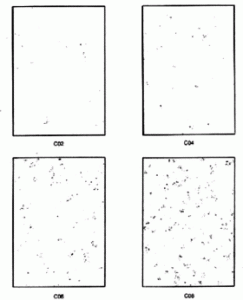
If are present in the material the carbon will collect into microscopic pockets during the sintering process. These pockets disrupt the Tungsten Carbide/Cobalt matrix and can affect the properties of the material.
Because the pockets like A and B type porosity C type porosity is rated by the ASTM at different levels. C-00 (carbon porosity free) up to C-08, but these rating do not correspond to total pore volume like A and B type porosity.
The term “porosity” simply refers to the presence of microscopic pores in the Tungsten carbide/Cobalt matrix. If the total porosity or if the volume of the largest pores present exceed a critical value, then the properties of the material can be affected.
Typical porosity is rated in three different types.
A-type refers to pores less the 10mirons in diameter
B-type refers to pores between 10microns and 40microns
C-type is based on excess carbon content and is addressed below
And at different levels according to the estimated total volume of porosity in the sample.
For example, a sample rated at A-02 B-00 C-00 porosity has pores less then 10microns in diameter with a total pore volume of .02% of the sample. A rating of A-04 B-02 C-00 indicates a total pore volume of .06% for pores less then 10microns across, .02% for pores between 10microns and 40microns and an overall pore volume of .08%.
Eta phase is a carbon deficient form of tungsten carbide that results in a harder, more brittle cemented carbide part. Insufficient carbon levels are generally the result of improper formulation of the carbide powder, long-term exposure of green parts to the atmosphere, or poor control of sintering conditions.

Recent Comments