Sintering is the process in which the tungsten carbide grains are fused into the cobalt matrix by heating the green material (carbide that has not been sintered is called green) to a high temperature.
There are variations of the sinter process:
- Hydrogen sinter, an early form of the sinter process where green carbide is heated in a form of hydrogen gas atmosphere, i.e. pure hydrogen, hydrogen/nitrogen gas mixture or dissociated ammonia.
- Vacuum sinter, in this process the green carbide is heated in a vacuum furnace either at vacuum or in a partial argon environment.
- Sinter-HIP, vacuum sinter with a post HIP operation, (Hot Isostatic Pressure). In this process the carbide is first vacuum sinter; at the end of the vacuum sinter process the vacuum is replaced by pressurized argon gas of many atmospheres. The vacuum sinter process creates a sealed envelope of molten binder metals around the carbide.
NOTE
Sinter-HIP should not be confused with a process sometimes called “post-HIP” or autoclave. In the Sinter-HIP process, sintering and HIPing are combined into a singe process step. In post-HIP the material is sintered then placed in a separate furnace to be re-heated and have pressure applied. Sinter-HIP takes place at much higher temperatures and lower pressure then post-HIP and is widely considered to produce a superior product.
It is the relative ability of one material to wear, abrade, deform or indent another material. Hardness is measured on some relative scale such as Moh’s, Rockwell, Vickers scales. The diamond is the hardest material known to man at this writing; all other materials have their hardness expressed in terms of it.
Note: Carbide Technologies measures hardness by the Vickers method for accuracy then converts the results to the Rockwell A Scale which is more easily recognized in the US.
Vickers Hardness Scale
| The Vickers Hardness test is applied to different materials across a wide range of hardnesses. The Vickers test uses a square-base pyramid shape diamond penetrator. The load many be varied: 5, 10, 20, 30, 50 or 120 kgf. The load is applied via the penetrator against the polished surface of the test specimen for 30 seconds. The resulting hardness reading depends on the load and the area of the pyramid penetrator’s impression, in accordance with the formula:

|
Relative hardness valves |
| Symbol |
Value |
Scale |
Range |
| HV |
1560 |
Vickers |
20~2400 |
| HRA |
92.0 |
Rockwell A-Scale |
59-95 |
| HM |
8.0 |
Mohs |
1-10 |
| HRC |
NA |
Rockwell C-Scale |
19-69 |
Rockwell Hardness Scales
| The Rockwell Hardness test presses a steel or diamond penetrator against a test specimen and measures the resulting indentation depth as a gage of the specimen hardness. The harder the material, the higher the HR reading. The letter suffix is used to show the test scale, as in HRA for Rockwell A scale.
In the test, a minor load (10 kgf) is first applied, and the test dial is reset to zero. Then a major load (60, 100, or 150 kgf) is applied to create the indentation. The major load is reduced back to the minor load, and the indentation depth determines the hardness.
The penetrator shape and load determine the Rockwell scale. Some commonly used scales are shown here. |
Scale |
Condition |
Application |
| A |
Brale indenter 60 kgf load |
Hard materials, such as tungsten carbide. |
| B |
1/16 in diamond ball
100 kgf load |
Medium to low hard materials, such as annealed carbon steels. |
| C |
Brale indenter
150 kgf load |
Materials harder than HRB 100, tool steels. |
| D |
Brale indenter
100 kgf load |
Casehardened materials. |
Rockwell Hardness Scales
Is the ability of a material to absorb energy of deformation, such as impact or load, without breaking or fracturing. High toughness requires both high strength and high ductility.
The most commonly used indicator of toughness in Tungsten Carbide is Transverse Rupture Strength. Transverse rupture strength is determined by breaking a carbide specimen of size .250in by .200in by .750in in the center of a 9/16in span at a rate of loading of 6800psi/sec.
Tungsten carbide is a homogenous mixture of tungsten carbide grains in a tough cobalt binder matrix. The tungsten carbide grains are fused into a solid matrix of cobalt metals. The term cemented carbides comes saying that the metal carbide’s grains are “cemented” in the binder metal’s matrix. The fusion process is called liquid phase sintering, or sinter for short.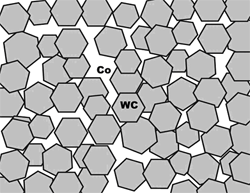
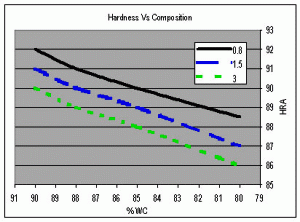
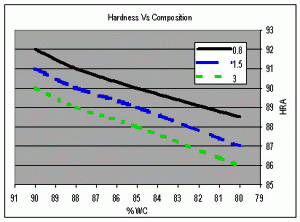
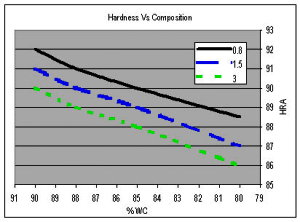
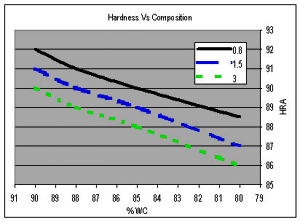
While there are many different grades of Tungsten Carbide available containing various additives for a variety of applications, on the most basic level the primary properties of any given grade (Hardness and Toughness) are determined by the ratio of Tungsten Carbide to Cobalt. In general, more a lower percentage of Cobalt will produce a harder but less tough material and a higher percentage will produce a tougher but softer material.
Hardness and Toughness Vs Composition


Recent Comments